

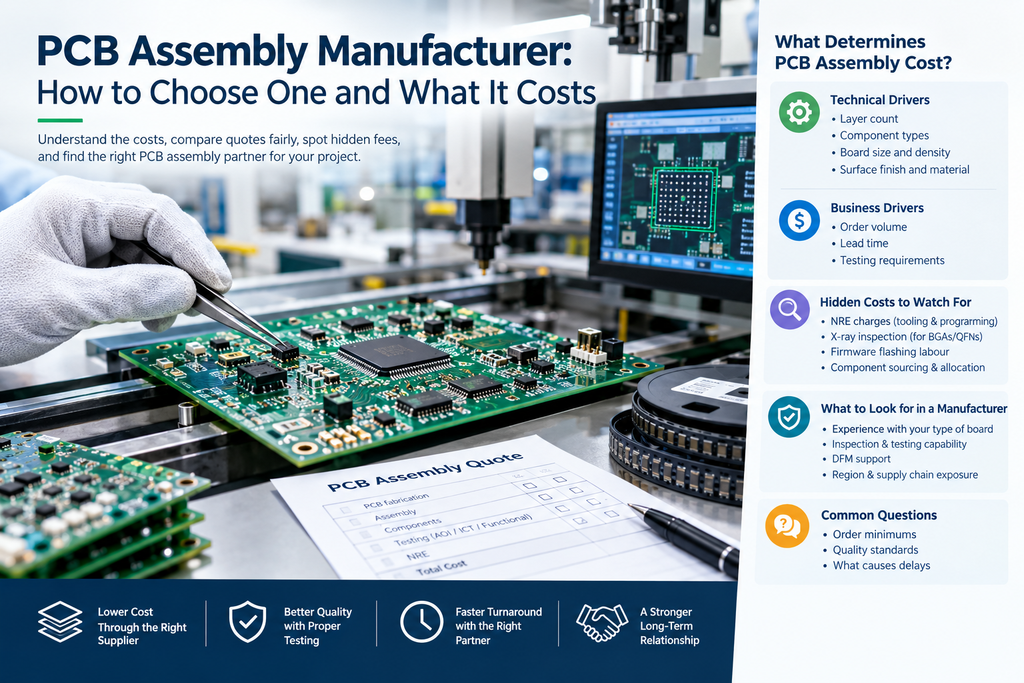
Choosing a PCB assembly manufacturer can feel deceptively simple before you get quotes back from different vendors. On the surface, two suppliers might seem identical on paper, but end up with a $40 gap on the boards between them – and the lowest number listed isn’t necessarily the lowest number when the board is finally completed and ready to ship out. This article explains the costs involved in pricing, what separates the wheat from the chaff, and answers engineers’ and buyers’ most-asked questions before they begin outsourcing to an assembly vendor.
What Determines PCB Assembly Cost?
There’s no catalogue price for PCB assembly. Every quote is built project by project from a mix of technical and business variables, which is exactly why two suppliers can quote wildly different numbers for what looks like the same board.
The technical drivers are the ones engineers control most directly:
- Layer count. Cost doesn’t scale with layers in a straight line — it’s closer to exponential, since each added layer means another lamination and drilling pass. A 4-layer board with careful ground-plane design often performs as well as a 6-layer board overspecified out of habit.
- Component types. Standard passives and common logic ICs are cheap and fast to source. Speciality ICs, custom connectors, or anything currently on allocation carry sourcing premiums that show up as line items you won’t see on the initial quote.
- Board size and density. More real estate and tighter component spacing both add pick-and-place time.
- Surface finish and material. Standard FR-4 with HASL finish is the cost baseline; high-Tg materials, Rogers substrates, or ENIG finishes push the price up fast.
The business drivers matter just as much:
- Order volume. Fixed setup costs (stencils, programming, line changeover) get spread across the batch, so a 10-unit prototype run carries a much higher per-board setup cost than a 5,000-unit production run.
- Lead time. Rushing a build means dedicated line time and priority component sourcing, both of which cost extra.
- Testing requirements. Basic visual inspection is usually included; X-ray for BGAs, in-circuit test, and functional test are often quoted separately.
Hidden Costs That Don’t Show Up on the First Quote
The number on a first quote and the number on the final invoice aren’t always the same, and the gap usually comes from a handful of predictable sources: non-recurring engineering (NRE) charges for tooling and programming, mandatory X-ray inspection on boards with bottom-terminated components like BGAs, and firmware-flashing labour if your product needs code loaded before it ships. None of these is unreasonable charges — they’re real work — but a supplier who buries them instead of itemising them upfront is a bad sign for how the rest of the relationship will go.
Component sourcing is the other quiet cost driver. When a part goes into allocation—meaning demand outstrips supply industry-wide—assembly houses charge premium rates just to secure it, and the market, not the assembler, sets that premium. Reviewing your BOM for allocation-prone parts before quoting can save a genuine surprise later.
How to Compare Quotes Fairly
You cannot make an adequate comparison between two PCB assembly quotes unless each quote uses the same inputs: fabrication files, BOM revision, assembly data, quantity, and quality. A quote that looks 20% cheaper is meaningless if it assumes a lower inspection tier or a different surface finish. Send every supplier the same package and ask them to flag any assumptions they made to fill gaps in your spec—that’s usually where the real price differences hide.
What to Look for in a PCB Assembly Manufacturer
Experience With Your Type of Board
A manufacturer that excels at high-volume consumer electronics doesn’t automatically have the process discipline a medical device or aerospace board requires. Ask for references from customers building something similar to what you’re building, not just a general portfolio.
Inspection and Testing Capability
Automated optical inspection (AOI) should be standard on any quote. If your board uses BGAs or QFNs, X-ray inspection isn’t optional — those joints are physically hidden and can’t be verified any other way. In-circuit test (ICT) and functional test confirm the board actually works electrically, which visual inspection alone can’t do.
DFM Support
A good manufacturer reviews your design for manufacturability before the first build and flags problems—a footprint that’s hard to place, a component that’s about to go end-of-life—while they’re still cheap to fix. Learning after a failed batch is the expensive way to get the same lesson.
Region and Supply Chain Exposure
Where you build a board affects both price and risk. Manufacturing in Asia (especially China) will usually yield the lowest price per board, and rapid turnaround due to the highly automated lines available and large quantities-though duties and geopolitical influences may increase costs or lead time while never showing up on the initial quote. US assembly generally yields a higher price per board. Still, it may make more sense for smaller volumes and projects that need greater IP protection or the benefit of a shorter, more direct supply chain than an additional percentage off the unit price.
What Are People Searching About PCB Assembly?
Beyond cost and supplier selection, engineers and procurement teams evaluating PCB assembly for the first time often ask the same questions: order minimums, quality standards, and what causes delays. The FAQ below covers the ones you should know before requesting your first quote.
Frequently Asked Questions
Can I order PCB assembly for just a handful of prototype boards?
Yes. Most assembly providers today accept small orders, including single-digit unit counts, largely because online quoting platforms have made low-volume work profitable. The catch is usually at the component level — individual passives like resistors and capacitors often carry their own per-line minimums, commonly around 50 pieces including reel waste, even when the board order itself is tiny.
Why do two suppliers quote such different prices for the same board?
Almost always because they’re quoting against slightly different assumptions — a different inspection tier, a different surface finish, a different interpretation of an ambiguous spec. Email the same files, BOM revision, quantity, and quality requirements to each supplier you are using for a comparison; ask them to tell you what they assumed. Apples to apples, or that’s the only way.
Does a lower quote always mean lower total cost?
Not always. Some NRE costs, obligatory X-ray when there are lots of BGA components, and firmware flashing work might be added later and make a quotation seem deceptively cheap compared to the final invoice. What gets included, and what doesn’t-ask right at the start.
How much does layer count actually affect price?
More than most engineers expect. The relationship isn’t linear — each additional layer means another lamination and drilling cycle, so cost climbs closer to exponentially than proportionally. Could any routing or grounding design reduce this signal-integrity issue to fewer layers without adding more?
Is manufacturing in China still the cheapest option in 2026?
Generally, yes, for per-board cost and speed, thanks to mature automated lines and lower labour costs. But semiconductor tariffs and ongoing supply chain disruptions have added real, sometimes unpredictable costs on top of the base price, so today’s cheapest quote isn’t guaranteed to remain the cheapest landed cost by the time the order ships.
What’s the biggest thing that causes assembly delays?
Component availability, not the assembly line itself. Speciality ICs, FPGAs, and parts in industry-wide allocation can have lead times measured in months regardless of how fast a manufacturer’s equipment runs. Checking part lead times against your BOM before submitting an order is the single most effective way to protect a delivery date.
Conclusion
Choosing a PCB assembly manufacturer comes down to matching the supplier’s strengths—cost structure, inspection capability, regional trade-offs—to what your specific board needs, rather than chasing the lowest number on a first quote. The suppliers worth building a long-term relationship with are the ones who itemise their pricing honestly and flag problems before they get expensive.
