

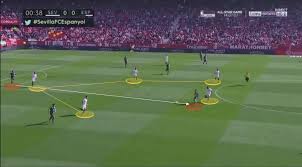
Deep‑block, counter‑attacking teams in La Liga 2016/17 did more than simply “park the bus”; they rebalanced matches by trading possession for space and transition chances. For bettors, understanding how these sides structured their low blocks and launched counters offered a way to spot mispriced underdogs or undervalued totals, because the game state they aimed to create often diverged from what raw league position suggested.
Why the low block plus counter model can beat expectations
A low block focuses on defending the final third with compact lines, reducing the space between defense, midfield and attack to protect the goal area. When combined with fast outlets up front, this structure trades ball possession for control of where play happens: opponents circulate the ball far from goal, while the deep‑block team waits for a turnover to attack the open field behind. This cause–effect pattern often compresses xG conceded per shot and creates high‑value transition chances, meaning a statistically “inferior” side can generate more dangerous attacks than its possession numbers imply, which in turn can produce better results than markets anchored on ball‑control metrics expect.
How La Liga 2016/17 favored deep defending for smaller clubs
Analyses of La Liga game styles show that deep defending and direct attacking existed alongside high‑press and elaborate possession as recognized patterns in Spain’s top flight. In 2016/17, many mid‑table and lower‑table teams adopted low blocks against stronger opponents, accepting long spells without the ball in exchange for compactness and counter space. This strategic choice helped narrow the gap against technically superior sides, especially at home, and contributed to the league’s reputation for tight, tactically controlled matches where goals did not always match attacking talent. For bettors, that meant some underdogs were more resilient than their budgets suggested, particularly when their low‑block habits matched up well against predictable possession teams.
Recognizing a genuine deep-block counter side, not just a weak team
Not every side that sits deep is strategically dangerous; some are simply forced back by stronger opponents without a clear plan to transition. A true deep‑block counter team shows repeatable traits: compact spacing, narrow defensive shape, and rehearsed patterns for springing forward once the ball is won. In 2016/17, these teams often attacked quickly through one or two key outlets, targeting channels behind advanced full‑backs or the half‑spaces vacated by overloaded midfields, turning rare possessions into disproportionately dangerous breaks.
Mechanisms that turn low possession into real threat
Mechanically, the low block’s value lies in how it concentrates players around the most valuable defensive space – the zone in front of goal – while leaving room behind the opponent’s defensive line. The moment a pass into congested central areas is intercepted, midfielders and forwards immediately run into depth, exploiting the opponent’s stretched shape. Because many La Liga possession teams pushed full‑backs high and committed midfielders forward, a single well‑timed vertical pass or dribble could produce a counter‑attack with a numerical or positional advantage, making the deep‑block side disproportionately dangerous relative to its possession statistics.
Checklist for using deep-block styles in pre-match decisions
To use these tactical patterns as an edge rather than a storyline, a pre‑match routine needs to connect specific stylistic traits to likely match dynamics. Instead of simply labeling a side “defensive,” the goal is to see whether its low‑block and counter structure is likely to function well against the particular opponent and context.
Questions to ask before backing or opposing a deep-block team
Before deciding how to play a match involving a low‑block counter side, you might consider:
- Does this team consistently defend with a deep line and narrow shape, with minimal space between defense and midfield, across a meaningful sample of games?
- Are there clear counter‑attacking outlets – a quick striker or winger – and patterns where transitions immediately target space behind opposing full‑backs rather than slow, lateral passes?
- How does the opponent typically attack: through patient possession and overlapping full‑backs, or through direct balls and crosses that are easier for a deep block to clear?
- Has this deep‑block side historically kept games close against stronger opponents, in terms of xG conceded and scorelines, or does it simply absorb pressure until it eventually breaks?
- Are key defensive and transitional players (centre‑backs, holding midfielder, primary counter runner) fit and available, or is the structure weakened by absences?
When answers point toward a compact low block facing a patient, predictable possession side, with healthy counter outlets available, the structure supports bets that assume closer games than the odds on the favorite might imply. If instead the opponent thrives against deep blocks with smart rotations and cutbacks, or the underdog lacks a real counter threat, the same “defensive” posture looks more like sustained survival, offering less value in handicaps or unders.
Integrating UFABET within a low-block, price-based approach
Once you have a clear view of how a deep‑block team’s style interacts with its opponent, the next step is to test whether the market price respects or ignores that structural resilience. Under a pre‑match analysis perspective, you might first model likely xG for and against based on style and context, then translate that into estimated probabilities for win, draw and goal ranges, and only then log in to a chosen sports betting service, for example ufabet168, to compare those probabilities with the available lines. This sequence prevents the interface from dictating where you look: you arrive with a prior belief that, say, the underdog’s low block should keep the game within one goal more often than implied, and use the displayed handicaps or totals to check whether the price still assumes a more open, one‑sided script than tactics justify.
When deep blocks create value – and when they don’t
Deep‑block counter teams create value when their structure directly exploits the favorite’s weaknesses. In 2016/17, possession‑heavy sides that struggled to break compact defenses with central combinations often resorted to speculative crosses, which low‑block defenses could clear repeatedly, turning the match into a low‑xG contest where a single counter could decide the result. In those situations, backing the underdog on a +handicap, considering unders, or even exploring draw outcomes could be rational, because the game state likely remained tight even if the favorite dominated territory. However, when low‑block teams faced opponents comfortable switching play quickly, using half‑space overloads and patient rotations, their compact shape was more easily pulled apart, weakening the logic behind trusting their ability to “hang in” at the price.
Conditional scenarios that flip the edge against deep-block sides
Certain conditions regularly turned the low block from an asset into a liability. If a deep‑block team conceded early, especially on the road, it was often forced to break its compact structure and chase the game, pushing full‑backs forward and opening the exact spaces it usually tried to protect. Late‑season scenarios where survival demanded wins also pushed some low‑block sides away from their best identity, leading to hybrid shapes that did neither defending nor attacking particularly well. Recognizing these triggers – early goals against, must‑win situations, or cumulative fatigue that reduced concentration – was crucial for avoiding automatic trust in the deep block simply because it had worked in previous, more favorable contexts.
Using a comparison table to structure low-block betting decisions
To make decisions consistent over many matches, you can map low‑block teams and their opponents into style categories and link those to typical betting implications. Research on La Liga game styles provides a foundation for such categorization, distinguishing deep defending with direct attack from other combinations.
| Matchup pattern | Likely tactical dynamic | Typical betting angle |
| Low block vs elaborate possession | Favorite dominates ball, few central breakthroughs | Underdog +handicap, unders, draw more attractive |
| Low block vs direct/transition attack | Many long balls, second balls around box | Higher volatility; corners and scrappy goals possible |
| Low block vs high press | Pressing team high, deep side clears and counters | Value depends on counter quality, risk of late collapse |
| Two low blocks | Slow tempo, limited risk‑taking | Strong structural case for lower goal lines |
This table makes explicit that “low block” is only half of the equation. The other half is how the opponent attacks and whether that approach tends to produce the sort of grind where deep defending shines, or the sort of wide, dynamic play that eventually pulls the block apart. By tying each pattern to a typical betting angle, you move from ad‑hoc judgments to a more systematic way of thinking about how to turn tactical matchups into positions against the price.
Positioning casino online within a long-term style-based strategy
Over a full dataset of 2016/17‑type seasons, serious bettors need a feedback mechanism to see whether their reading of low‑block value actually outperforms the market. Treating any chosen casino online context as the end point of a style‑based process – where every wager on deep‑block underdogs, totals and related props is logged with notes on tactical matchup, closing line and result – allows you to analyze patterns across time. This record can reveal, for example, that backing low blocks against elaborate possession in mid‑table clashes produces better returns than backing them against direct, physically dominant opponents, prompting refinements in which situations you treat as genuine pricing errors and which you leave alone.
Summary
Targeting deep‑block, counter‑attacking teams in La Liga 2016/17 for betting value is reasonable because their compact defending and transition threat often made matches tighter and more balanced than possession or reputational metrics implied. The edge, however, came only when their style intersected favorably with the opponent’s attacking approach and broader context, and when bettors integrated that tactical understanding into a structured pre‑match routine that used odds screens purely to test, not to invent, their hypotheses. By consistently linking low‑block mechanisms to match dynamics and recorded outcomes, it becomes possible to move from occasional “park the bus” upsets toward a deliberate strategy for finding and exploiting mispriced deep‑defending sides.