

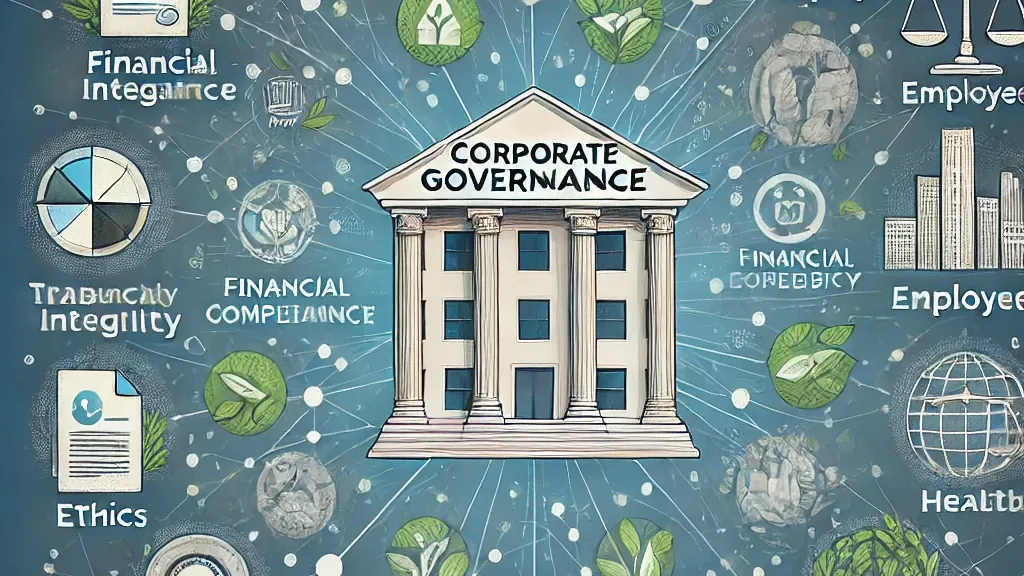
Corporate governance sounds like paperwork. It is not. It is the system that keeps a company from drifting.
It sets the rules. It defines who decides. It builds accountability before problems happen.
Companies with strong governance last longer. They react faster. They avoid preventable mistakes.
A McKinsey study found that companies with effective governance practices show lower volatility during economic downturns. That matters when markets shift fast.
Stability is not luck. It is designed.
What Corporate Governance Actually Means
Corporate governance is how a company is directed and controlled.
It includes:
- The board of directors
- Executive leadership
- Risk management systems
- Compliance programs
- Internal controls
It answers simple questions.
Who approves major decisions?
Who reviews those decisions?
What happens when something breaks?
Without clear answers, confusion spreads.
One governance leader once told a team during a policy rewrite, “If a manager needs a lawyer to explain this policy, it’s already failed.” That moment forced the team to rewrite everything in plain language.
Clear rules get used. Complex ones get ignored.
Why Governance Drives Stability
Risk Gets Managed Early
Every company faces risk. It can come from markets, leadership decisions, or internal failures.
Governance systems catch risk early.
The Association of Certified Fraud Examiners estimates that companies lose about 5% of revenue to fraud each year. Strong internal controls reduce both the size and length of fraud cases.
Risk does not disappear. It gets controlled.
A compliance officer once noticed a small reporting gap in a quarterly review. It looked minor. The governance system flagged it anyway. That small issue turned into a larger fix that prevented a major reporting error later.
Small checks prevent big problems.
Decisions Become Traceable
Weak governance leads to unclear decisions.
No one knows who approved what. Meetings happen without records. Issues get passed around.
Strong governance creates traceability.
Every major decision has a record. Every approval has a name attached.
This builds accountability.
A corporate secretary once described a late-night call after a compliance issue surfaced. “We pulled the approval chain in ten minutes. No guessing. No arguing. The system showed us everything.”
That speed comes from structure.
The Role of the Board of Directors
The board is not just a formality. It is the control layer.
Boards review strategy. They oversee risk. They hold executives accountable.
PwC reports that nearly 50% of directors believe boards need stronger risk oversight skills. That gap creates exposure.
Strong boards ask direct questions.
- What assumptions are we making?
- What risks are we ignoring?
- What happens if this plan fails?
A board member once stopped a proposal with one question: “Show me the downside scenario.” The team had not prepared one. The plan was delayed and improved.
Good boards slow bad decisions. That is their job.
Ethics and Compliance Systems
Ethics programs are not slogans. They are systems that must work under pressure.
They include:
- Reporting channels
- Investigation processes
- Clear consequences
- Training programs
The U.S. Sentencing Commission states that effective compliance programs can reduce penalties when violations occur. That creates real financial impact.
More important, these systems build trust inside a company.
An employee once used a reporting hotline to raise a small concern about vendor relationships. The issue was minor. The system worked. The company fixed it fast. More employees started using the system after that.
Trust grows when systems respond.
Financial Controls and Transparency
Financial reporting drives investor confidence.
Strong governance ensures:
- Accurate reporting
- Independent audits
- Clear documentation
After major accounting failures in the early 2000s, stricter rules forced companies to improve internal controls. Those controls are now standard.
Companies that ignore them face consequences.
A finance leader once shared a story from a reporting cycle. “We caught a misclassification the night before filing. The control worked. Without it, we would have filed incorrect numbers.”
Controls are boring. They also save companies.
Practical Steps to Improve Governance
Governance can be improved with simple actions.
1. Define Decision Ownership
Write down who approves what. Update it often. Remove overlap.
2. Simplify Policies
Short policies get followed. Long policies get skipped.
Rewrite rules in plain language.
3. Test the System
Run simulations.
What happens if revenue drops 25%?
What happens if a key leader leaves?
Test before the crisis.
4. Strengthen Reporting Channels
Make it easy to report issues. Protect anonymity. Track response time.
5. Train Leadership
Boards and executives need ongoing education. Risk changes. Rules change.
Training keeps decisions sharp.
Governance in Crisis Situations
Crisis exposes weak systems.
Companies with strong governance respond faster. They already have escalation paths.
During the 2008 financial crisis, firms with independent risk oversight performed better than those without, according to research published in the Journal of Financial Economics.
Preparation beats reaction.
A legal executive once recalled reviewing crisis protocols before a regulatory shift. “We had a checklist ready. Others were still figuring out who should lead the response.”
Speed comes from preparation.
Governance as a Competitive Advantage
Governance is not just defensive. It can drive growth.
Investors prefer companies with strong oversight. It reduces uncertainty.
Lower uncertainty can lower cost of capital.
Institutional investors often review governance ratings before investing. Companies with stronger governance attract more attention.
One executive summarized it clearly during a strategy session. “Investors don’t just buy results. They buy confidence in how those results are produced.”
Governance builds that confidence.
In practice, leaders like Shannon Kobylarczyk have shown how combining legal structure with business understanding creates systems that last. That approach turns governance into a tool, not a barrier.
Final Thoughts
Corporate governance builds long-term business stability by creating structure.
It defines decisions.
It controls risk.
It enforces accountability.
It protects trust.
Companies that ignore governance rely on luck. Companies that build it rely on systems.
Systems scale. Luck does not.
The best companies treat governance as part of strategy, not a checklist.
It is not flashy. It does not grab attention.
But it keeps everything running.
And over time, that makes all the difference.
