

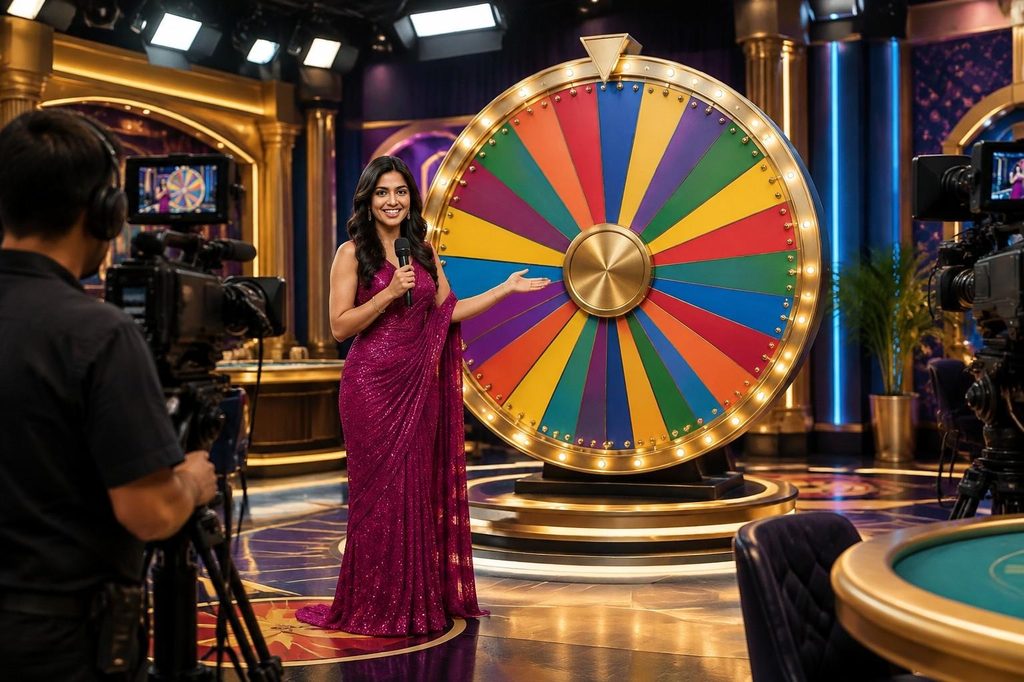
A live game show looks effortless from the viewer’s side: a presenter, a table, a stream that never seems to blink. The odd pause before the next card or the next spin is where that polish shows its workings.
Many viewers read the hesitation as stalling. Watch what surrounds it – the cleared table, the steady camera, the presenter glancing at a cue – and it starts to look like production.
That pause is part of the studio’s rhythm. A live game show table is a small broadcast set: real cards or a real wheel, cameras covering every movement, and a digital interface layered on top. Anyone who has opened a live casino in india stream and simply watched one full round has seen that machinery at work.
The pace feels slower than software because the studio is doing visible work.
Count what has to happen between two deals and the stream starts to look less like a webcam and more like a small television programme. The feed has to carry video, betting data and timing in the order the table produces them, and every one of those jobs leaves a mark on the rhythm.
Software speed versus a shared clock
Software-generated games run on a different logic. The outcome is produced according to programmed rules, and the interface displays it without waiting for a physical action. Nothing on screen depends on a person’s hands, so a round can move as fast as the interface allows.
The viewer sets the pace and nobody waits for a presenter. That is efficient, but it offers little sense of an event, because there is no set and no audience – only a display.
What the software version hides
Because the action is generated, there is nothing to watch. The shuffle, the cut and the draw all happen inside a server, and the screen simply reports the outcome.
There is no set to light, no presenter to schedule, no camera to keep in focus. A live show inverts that: the physical actions are the point, and the software’s job is to keep up with them.
Why everyone waits together
A live show replaces that private loop with a shared one. The presenter sets the tempo by dealing, spinning and settling each round in full view, and software timers help coordinate everyone watching. The result is a clock that belongs to the whole audience rather than to any single viewer.
Some live tables have a limited number of seats, and chat adds another task for the presenter to manage. Neither has an equivalent in the software version.
Several studio tasks shape the rhythm of a round:
- The shuffle, the cut or the reset of a wheel, done by hand and kept in camera view.
- A decision window that gives every connected participant time to act before the presenter proceeds.
- The clearing of the table, so the playing surface stays readable on camera.
- Optical recognition, which relays what happens on the table to the digital interface.
Presenters train for a steady pace and clear movements, and much of the timing is cued by software rather than by a floor manager. The rhythm you notice is designed, not improvised.
One illustrative round in the studio
To see where the seconds actually go, take a single studio round. This illustrative sequence brings together several common elements of live-dealer production.
- The preparation happens in frame. Cards are shuffled, or a wheel is reset, on camera before the round begins.
- The decision window opens and closes. Software counts down a fixed window so every participant can act before the presenter moves on.
- The presenter keeps the action readable. Clear movements and a steady pace help viewers follow the physical action on screen.
- Cameras and optical recognition capture the result. A live table typically uses three to five cameras, including a wide shot, a tight overhead or raked view of the playing surface and a presenter close-up, while recognition systems relay the action to the digital interface.
- The round settles in a fixed order. Results are confirmed and cleared in sequence, so the screen never shows an outcome before the table has physically produced it.
A control room sits behind all of this, with staff watching multiple feeds and system screens so table actions and the stream stay in the same sequence.
Much of the camera switching is event-driven, triggered by what the recognition systems detect rather than called by a director in real time. Presenters carry the show without a floor manager, handling continuity, responding to chat and holding the pace the software sets.
Even the sound is engineered rather than added later. Presenters wear small lavalier microphones with backup packs, table microphones keep the shuffle audible, and the audio mix stays dry because there is no post-production stage to sweeten it.
What lands on your screen is meant to be a record of something that physically happened, in the order the table produced it.
Three formats and what they ask of a studio
Put the common formats side by side and the production demands become easier to see: software-only games, studio-built live shows and streams from a real venue floor. The differences that matter are where the result comes from, who owns the clock, and how much of the process the cameras have to carry.
Software-generated action needs no physical set at all. A studio show needs a set, cameras, lighting, sound and a crew. A floor stream borrows someone else’s room and adapts its camera work to a space that was never designed for broadcast.
In a studio format, camera coverage makes the physical action readable while software helps maintain the shared rhythm. Behind the presenter, control-room staff monitor camera feeds and system performance throughout the broadcast. That oversight is one of the quiet reasons a live show holds together.
Trading speed for visible proof
Circle back to that pause before the next card. Fewer rounds per hour is a real trade-off of a live production: the format gives up raw speed for a process that can be seen. Chat adds texture, and it adds seconds too.
The upside is that the slowness is legible. A real shoe, clear movements and coordinated camera feeds make a carefully timed production process visible from the outside. A pause can give the physical action and its on-screen presentation time to stay in sequence.
For the production team, a steady pace gives every physical action a clear place in the broadcast sequence. For the viewer, the same steadiness makes a session easier to follow and easier to keep within the time and money limits set beforehand.
What looks like a simple stream is a coordinated production, with presenter, cameras, sound and software working to a shared rhythm. The next time a live game show pauses before the next card, take it as an invitation to notice the production behind the game.
