

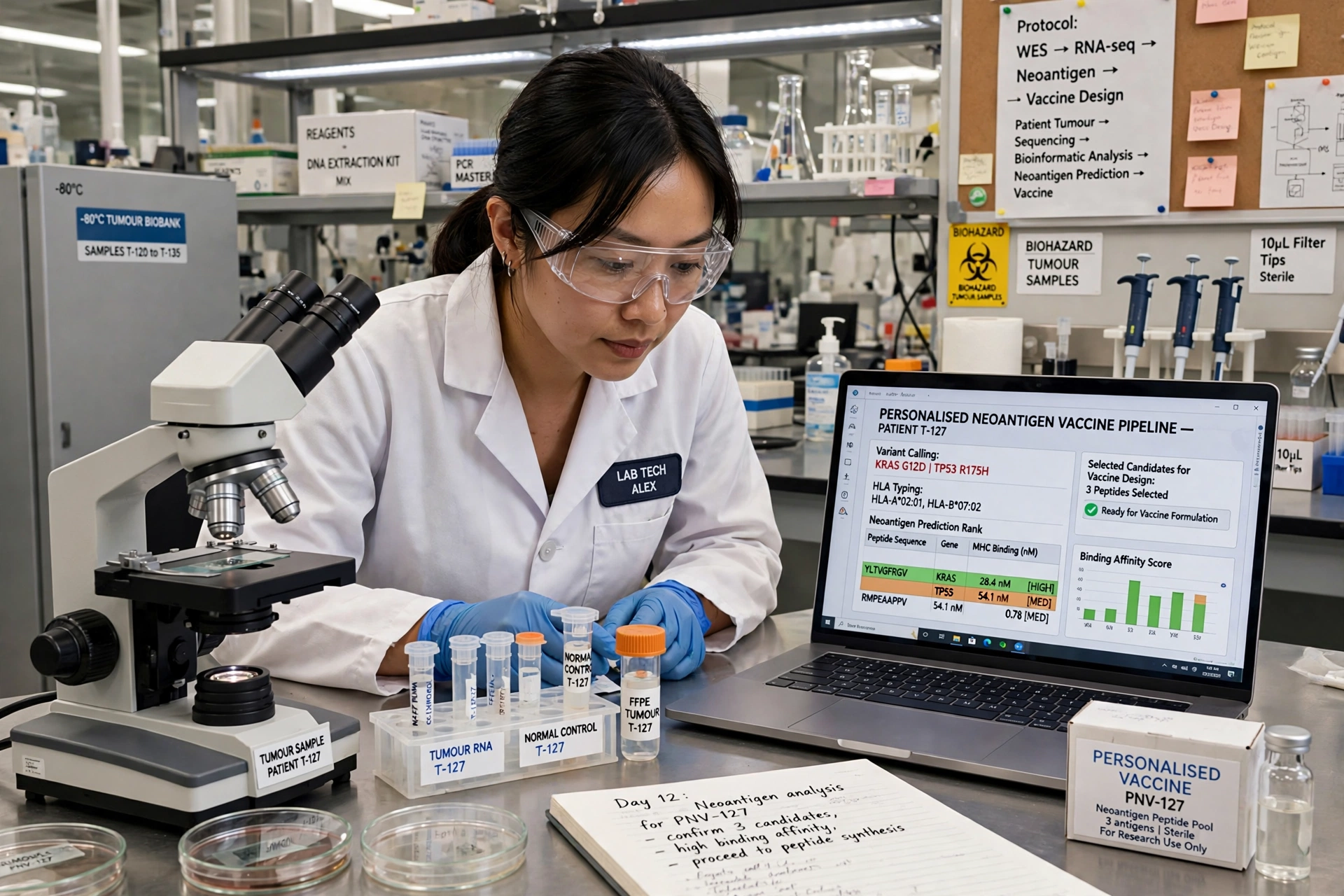
Most drugs are made by the million and stored until needed. NeoVax is made one dose at a time, for one named patient, from the mutations in that patient’s own tumour. A phase 1 trial, published in Nature Medicine, has now tested that personalised neoantigen vaccine combined with nivolumab in platinum-sensitive recurrent ovarian cancer. Its questions were deliberately narrow: could the vaccines be manufactured and given, was safety acceptable, and did the immune system respond? Our technology readers, who followed our coverage of technology changing cancer detection, will recognise the pattern: powerful method, early evidence, long road ahead.
From tumour sample to vaccine blueprint
The process starts with sequencing. A sample of the patient’s tumour is analysed to find mutations that produce neoantigens, abnormal protein fragments that healthy cells do not display. Computational tools help predict which of those fragments the immune system is most likely to notice. The selected targets then become the recipe for that individual’s NeoVax vaccine. It is manufacturing as a service built around a single genome, which is why feasibility is a genuine research question rather than an administrative detail. If the recipe cannot be produced in time, the concept fails before biology is even tested.
Adding a checkpoint inhibitor
Patients also received nivolumab, a PD-1 immune checkpoint inhibitor. The National Institutes of Health and other research bodies describe checkpoint inhibitors as drugs that release brakes on immune cells. The combination has a clear rationale: teach T cells to recognise tumour-specific neoantigens with the vaccine, then reduce the chance that the tumour’s checkpoint defences silence those same T cells. Pairing a teaching signal with a brake release is elegant in theory. The trial’s job was to find out whether it was workable and tolerable in practice.
Feasibility was the primary test
Phase 1 trials are sometimes misread as small versions of efficacy trials. They are not. This study’s centre of gravity was feasibility and safety in a defined group: women whose ovarian cancer had recurred but remained platinum-sensitive. Could each bespoke vaccine be built and administered alongside nivolumab in a real clinical workflow? The answer reported in Nature Medicine was yes. That matters because personalised manufacture involves sequencing, prediction, production and quality checks all running against the clock of a progressing disease.
Safety and the immune readout
Safety was assessed as acceptable for this early-phase setting, and immune monitoring showed T-cell responses consistent with the vaccine doing its intended job of flagging neoantigen targets. Those two findings are the payload of the study. An acceptable safety profile means the approach can be studied further without an immediate stop signal. Measurable T-cell responses mean the personalised design is not merely theoretical: the immune system can be directed, at least partly, by a vaccine built from tumour data. Both findings stop well short of demonstrating clinical benefit.
No efficacy claim follows from this
Nothing in a small phase 1 feasibility study can establish that NeoVax extends survival, delays recurrence or shrinks tumours, and this report makes no such claim. There was no design here that could isolate that kind of benefit reliably. Readers should be wary of any summary that turns immune response into outcome, because a T-cell signal in a blood test and a longer, better life for patients are different endpoints separated by years of further testing. Keeping that distinction clear protects patients from false hope and good science from inflated expectations.
Scaling a factory of one
If larger trials eventually show benefit, the manufacturing challenge becomes the story. Personalised vaccines need faster sequencing, better prediction of useful neoantigens, and production systems that can handle many individual recipes at once without errors. Those are technology and logistics problems as much as medical ones. For now, the trial delivers a measured milestone: in recurrent ovarian cancer, a vaccine built from each patient’s tumour could be made, combined with nivolumab, given with acceptable safety, and met by immune responses. Larger studies must now decide whether that promise translates into outcomes that matter.
