

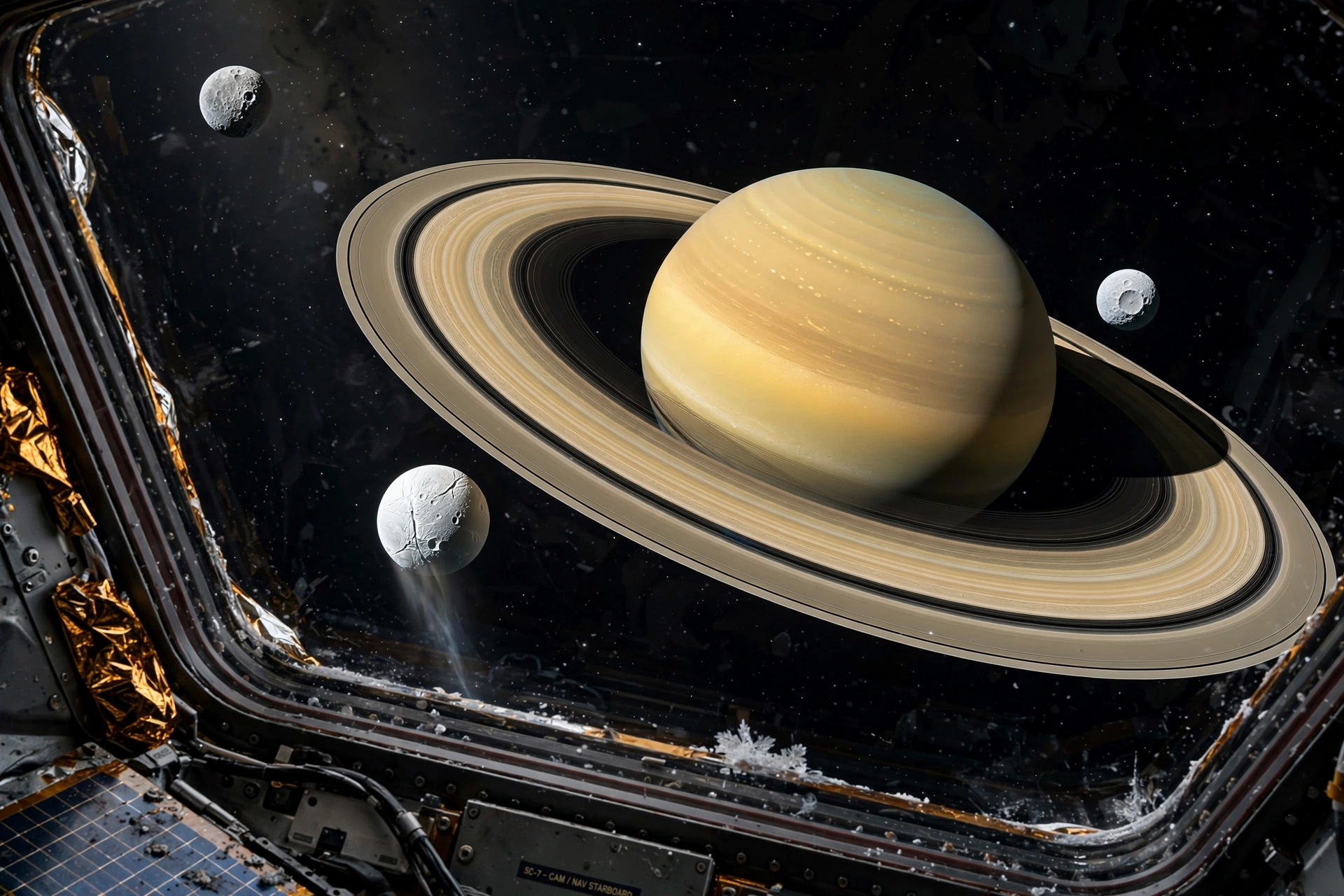
For a technology audience, the most interesting part of Saturn’s new moon record is not the number itself, impressive as 274 is. It is the method. Astronomers using the Canada-France-Hawaii Telescope have confirmed 128 new moons of Saturn, up from a previous total of 146, by squeezing signal out of images in which these worlds are almost invisible. It is a story about instruments, software and patience, much like the data-centre questions explored in our recent technology coverage, where scale changes what is possible.
A record recognised, not just observed
The 128 objects have been recognised by the International Astronomical Union, which means their orbits are established well enough to count them as genuine moons. That formal step separates a detection from a discovery claim. Teams must observe a candidate repeatedly, across a long arc of its orbit, until its path around Saturn is beyond reasonable doubt. The announcement therefore marks the end of a verification pipeline that ran for years, not a sudden glimpse through an eyepiece on one clear Hawaiian night.
CFHT and the Mauna Kea advantage
The Canada-France-Hawaii Telescope sits on Mauna Kea, where high altitude and stable air make faint-object astronomy practical. Its instruments and programmes are described by the telescope’s own observatory. The survey team included University of British Columbia researchers, among them Dr Edward Ashton, who specialise in the dim outer populations of the giant planets. Their observing strategy was repetitive by design: image the same region around Saturn many times, over several years, so that moving objects reveal themselves against the fixed stars behind them.
Shift and stack, in plain terms
Here is the core technique. A sequence of deep exposures is shifted digitally, frame by frame, at the rate a Saturn moon is expected to move across the sky. The shifted frames are then stacked. Anything moving at that chosen rate lines up in every frame and grows brighter in the combined image. Anything moving differently blurs out. By trying the rates and directions that Saturn’s irregular moons should follow, astronomers can recover objects a few kilometres wide that no single exposure could show. Computing, in effect, becomes part of the telescope.
What kind of moons the software found
The objects it recovered are irregular moons: small, distant and eccentric in the astronomical sense. Their orbits are tilted well away from Saturn’s equatorial plane, and many are retrograde, travelling opposite to the planet’s rotation. Those properties point to capture. Rather than forming in the disc that built Saturn’s large inner moons, these bodies likely arrived from elsewhere and were trapped by gravity. Their small size, often just a few kilometres, explains both why they stayed hidden so long and why image processing mattered more than raw telescope power.
Collision families in the data
Once the orbits were measured, patterns emerged. Many new moons travel in loose groups with similar orbital angles and distances, and researchers think those groups are fragments of larger captured moons destroyed in collisions. A single impact can turn one parent body into a family of shards that orbit together for billions of years. In that sense the survey is reading a debris record. The technology finds the dots; the orbital analysis reconstructs an ancient break-up that no human witnessed, written only in where the pieces still travel today.
Lessons for the next generation of surveys
Saturn’s total of 274, more than all other planets combined, will encourage similar deep searches elsewhere. The lesson is that discovery now depends as much on archives, algorithms and follow-up scheduling as on glass and steel. Telescopes collect photons, but software decides which photons become a moon. As survey datasets grow, techniques like shift and stack will only become more important, and the moon counts of the outer planets may keep climbing. Saturn, for the moment, is the proof of concept: a familiar planet with a hidden population that technology finally brought into view.
