

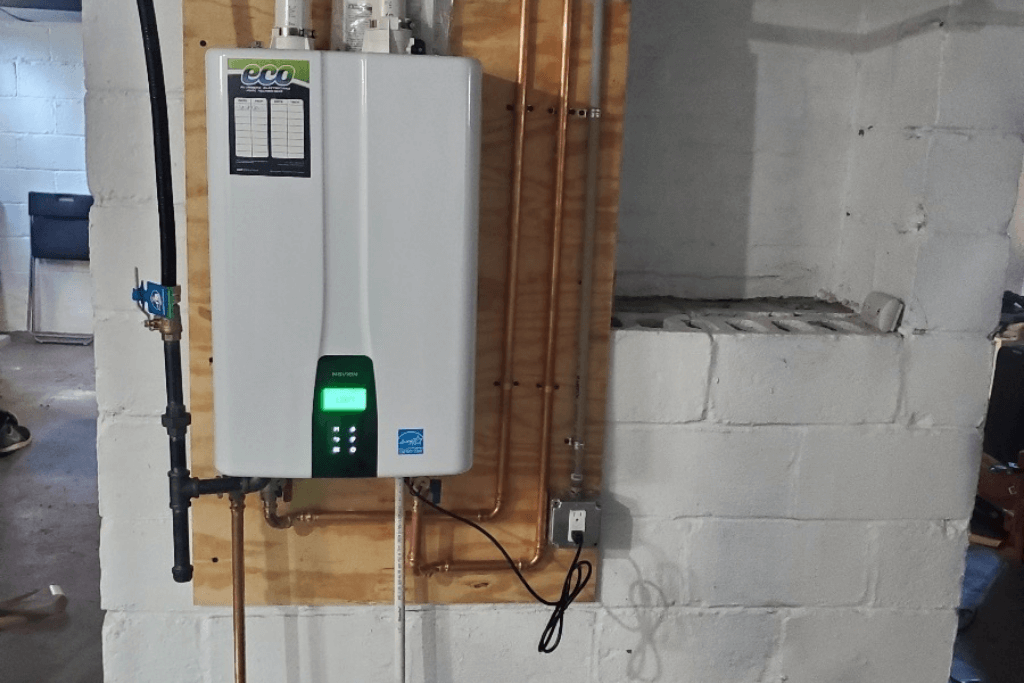
Houston ranks among the top cities in the United States for water hardness. Depending on your neighborhood, tap water here can carry anywhere from 150 to over 400 parts per million of dissolved minerals, mostly calcium and magnesium. For most appliances, that is an inconvenience. For a tankless water heater, it is a slow death sentence.
The problem is invisible for months, sometimes years. Then one day your water heater throws an error code, your hot water flow drops to a trickle, or the unit shuts off entirely. By that point, scale has built up inside the heat exchanger to the point where repair may not be worth the cost.
Here is what is actually happening inside your unit, why it accelerates faster than most homeowners expect, and what you can do before it becomes a replacement bill.
What Hard Water Actually Does Inside a Tankless Unit
Unlike a traditional tank water heater, where scale accumulates across a large surface area over years, a tankless unit concentrates heat through a narrow heat exchanger. Water passes through small copper or stainless coils and gets heated almost instantly.
That rapid heating is the efficiency advantage. It is also why scale is so destructive.
When water heats quickly, dissolved calcium and magnesium precipitate out and bond to the inner walls of the heat exchanger. The narrower the passage, the faster the buildup. Over time, a layer of limescale forms that acts as insulation. The unit has to work harder to achieve the same output temperature, which stresses the burner and the internal components.
According to the Water Quality Association, just 1/4 inch of scale buildup can reduce heating efficiency by up to 40%. In Houston’s water conditions, that level of buildup is realistic within 12 to 24 months if the unit runs without any form of protection or maintenance.
The Heat Exchanger Is the Most Expensive Part to Replace
Heat exchanger replacement often costs between $700 and $1,200 in parts alone, and that assumes the part is available for your specific model. Many homeowners discover the replacement cost approaches or exceeds the price of a new unit.
This is not a hypothetical. It is the most common reason tankless water heaters in Houston fail prematurely, usually between years three and six when they should still have a decade or more of service life ahead of them.
Signs Your Tankless Water Heater Is Already Struggling with Scale
Scale does not announce itself. But the symptoms are recognisable once you know what to look for.
- Inconsistent hot water temperature. The unit fluctuates between scalding and lukewarm, even with a steady flow rate. Scale disrupts heat transfer unevenly across the exchanger.
- Reduced flow at hot water fixtures. Mineral buildup can partially block internal passages, restricting how much water moves through the unit.
- Error codes on the display. Most modern tankless units have diagnostic systems. Error codes related to overheating, pressure, or flow often trace back to scale when other causes have been ruled out.
- Longer time to reach temperature. If you are waiting noticeably longer for hot water than you did a year ago, the heat exchanger is likely working harder than it should.
- Rumbling or popping sounds during operation. Trapped air pockets and mineral deposits create audible stress as water tries to move through restricted channels.
Any one of these on its own might be a minor issue. Two or more together, especially in a Houston home without a softener or filtration system, point strongly toward scale accumulation.
How to Protect a Tankless Water Heater in Hard Water Conditions
The good news is that hard water damage to tankless units is almost entirely preventable. It requires a layered approach, not a single fix.
1. Annual Descaling (Flushing with Vinegar or Citric Acid Solution)
Most tankless water heater manufacturers recommend descaling once a year. In Houston’s water conditions, many plumbing professionals recommend every six to nine months for units without upstream filtration.
The process involves connecting a submersible pump and bucket to the unit’s service valves, circulating a descaling solution through the heat exchanger for 45 to 90 minutes, then flushing with clean water. Rinnai, Navien, and Noritz all publish specific descaling procedures for their models.
This is a task a competent DIYer can manage with the right kit. However, if the unit has not been descaled in two or more years, having a licensed plumber assess the heat exchanger condition first is worth the time.
2. Install a Whole-Home Water Softener or Dedicated Pre-Filter
Descaling treats the symptom. A water softener treats the source.
A salt-based ion exchange softener upstream of your water heater replaces calcium and magnesium ions with sodium, which does not precipitate and does not bond to heat exchanger surfaces. This dramatically reduces scale accumulation, extends service life, and also protects washing machines, dishwashers, and plumbing throughout the home.
A quality whole-home softener for a typical Houston house runs between $800 and $2,500 installed, depending on capacity and water hardness. That is a fraction of what a heat exchanger replacement or early unit replacement costs.
If a full softener is not in the budget immediately, a dedicated scale inhibitor filter installed on the cold-water inlet to the tankless unit is a meaningful intermediate step. It will not eliminate the problem entirely, but it significantly slows mineral accumulation.
3. Set the Unit Temperature Correctly
Higher water temperatures accelerate scale formation. Most manufacturers recommend setting tankless units to 120 degrees Fahrenheit as a default. In hard water areas, that recommendation matters more than usual.
Running the unit hotter does not just waste energy. It drives mineral precipitation faster and shortens the window between descaling sessions.
4. Check Inlet Filter Screens Regularly
Most tankless units have small inlet filter screens that catch debris before it enters the heat exchanger. In Houston, where sediment and mineral particles are common, these screens can clog faster than expected.
A clogged inlet screen restricts flow, causes the unit to work harder, and can trigger the same error codes that scale produces. Checking and cleaning these screens every three to four months takes minutes and can prevent misdiagnosed service calls.
5. Work with a Plumbing Company That Knows Tankless Systems
Not every plumber has hands-on experience with tankless maintenance and diagnostics. Tankless units have different failure modes, different service intervals, and brand-specific error code systems that general service experience does not always cover.
When evaluating who handles your unit, look for a plumbing company that has specific tankless installation and maintenance experience and can speak to your water quality conditions in the Houston area. The difference in outcome between a knowledgeable technician and a generalist is often whether the heat exchanger survives or gets replaced.
Does Water Quality Also Affect the Pipes Feeding the Unit?
Yes, and this is the part most homeowners do not consider until they are already dealing with two problems at once.
Hard water and older galvanized or copper supply lines are a compounding issue. Scale from hard water accelerates corrosion inside aging pipes, and corroded pipe fragments can reach the tankless unit’s inlet filter or, worse, the heat exchanger itself.
If your home has galvanized steel pipes, which are common in Houston homes built before the 1980s, the water feeding your tankless unit may already be carrying rust and sediment alongside the mineral content. In that scenario, protecting the water heater also means addressing the pipe condition upstream.
Key Takeaways
- Houston’s water hardness, often 150 to 400+ ppm, makes tankless water heaters significantly more vulnerable to scale buildup than in softer water regions.
- Scale accumulating inside a heat exchanger is the leading cause of premature tankless failure in the Houston area, and it develops faster than most homeowners expect.
- Annual descaling is the minimum maintenance standard; every six to nine months is more realistic for unprotected units in Houston conditions.
- A whole-home water softener upstream of the unit is the most effective long-term protection strategy, with ripple benefits across all water-using appliances.
- Older galvanized supply lines compound the problem. Addressing pipe condition and water quality together produces better outcomes than treating either issue in isolation.
FAQ
How often should a tankless water heater be flushed in Houston? In Houston’s hard water conditions, once a year is the manufacturer-standard minimum, but most experienced plumbers recommend every six to nine months for units that do not have a water softener or scale inhibitor installed upstream. If you have already had the unit for two or more years without a flush, start sooner.
Will a water softener void my tankless water heater warranty? No. Installing a water softener upstream of a tankless unit does not void the manufacturer’s warranty. In fact, several manufacturers explicitly recommend water treatment in hard water areas to protect the heat exchanger and maintain warranty validity. Check your specific model’s documentation for any water quality specifications.
Can I descale a tankless water heater myself? Yes, with the right kit and some mechanical comfort. Most hardware stores and online retailers sell descaling kits specifically for tankless units, and manufacturers like Rinnai and Navien publish step-by-step instructions. However, if you are unsure about the service valve locations, or the unit has not been maintained in several years, having a licensed plumber do the first flush and inspect the exchanger condition is a smart starting point.
What water hardness level requires a softener? The U.S. Geological Survey classifies water above 121 ppm as hard and above 180 ppm as very hard. Much of Houston sits well above both thresholds. At those levels, a water softener is not a luxury upgrade. It is basic appliance protection.
Where can I find out more about comprehensive plumbing services in Houston, including tankless water heater installation and maintenance? Repipe Solutions Inc covers tankless water heater installation and a range of residential plumbing services across the greater Houston area, including water filtration systems that address the hard water issues described in this article.
Final Thought
Tankless water heaters are excellent technology. The efficiency gains, the continuous hot water supply, the space savings, all of it is real. But they are precision appliances operating in a harsh mineral environment here in Houston, and they need more proactive maintenance than most homeowners realise when they first install one.
The cost of prevention, annual descaling plus a water softener, is a fraction of what early heat exchanger failure or unit replacement costs. Getting into a maintenance routine early is simply the smarter financial decision, and it means the appliance actually delivers the 20-year service life it was built for.
